
Specializing In The Production Of Gabions, Fences, Sound Barriers, Protective Barriers And Other Products
Author:
Shitai Wire Mesh
Release Time:
Jul 17,2026
Complete 2026 stone gabion buying guide for Philippines contractors and engineers. Compare types, local stone sources, DPWH standards, regional pricing, and step-by-step installation tips.
Article overview
This buying guide is written for Philippine engineering contractors, procurement managers, and DIY homeowners evaluating stone gabion solutions in 2026. It compares product types, local stone compatibility, regulatory standards, typhoon-season performance data, and verified regional pricing — giving you the decision-ready information most supplier websites simply do not provide.
Table of contents
- 1. What is a stone gabion?
- 2. Types of stone gabion structures
- 3. Local stone sources in the Philippines: which works best?
- 4. DPWH and NSCP compliance: what Philippine engineers must know
- 5. Typhoon-season durability: how stone gabions perform under Philippine conditions
- 6. Regional pricing guide: Luzon, Visayas, and Mindanao (2026 data)
- 7. How to install a stone gabion: step-by-step for Philippine homeowners
- 8. FAQ
What is a stone gabion?
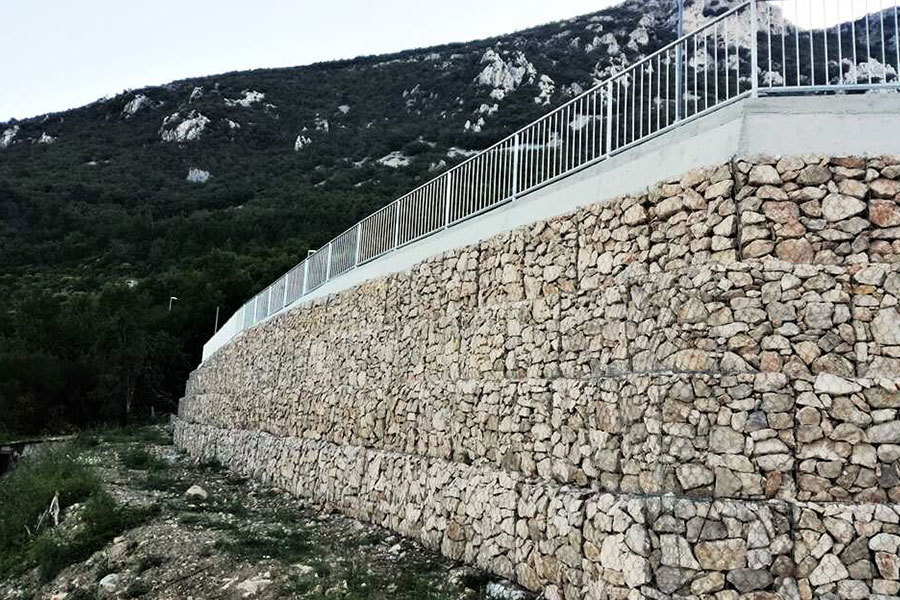
A stone gabion is a wire mesh basket filled with rocks or stones, assembled into modular units used for retaining walls, slope protection, and flood control. The concept is deceptively simple, yet the engineering behind it has supported bridges, riverbanks, and hillside terraces across the world for well over a century. In the Philippines, where heavy monsoon rains and frequent typhoons accelerate soil erosion at an alarming rate, stone gabion systems have become a go-to solution for both public infrastructure projects and private residential landscaping.
Unlike rigid concrete structures, a gabion wall behaves as a flexible system. It absorbs ground movement, allows water to drain freely through the rock-filled cage, and gradually integrates with the surrounding landscape through natural vegetation. That combination of structural resilience and ecological compatibility is exactly why demand across Southeast Asia continues to grow. According to recent market research, the global gabion market was valued at approximately USD 3.2 billion in 2023, with a projected CAGR of 4.8% through 2030 — and emerging markets like the Philippines are a meaningful part of that trajectory.
Why do so many buyers still end up confused at the procurement stage? Partly because the term "stone gabion" covers a surprisingly wide range of products, sizes, and wire specifications, and partly because not all suppliers are transparent about which products actually meet local engineering standards. This guide addresses both problems directly.
For a broader technical background, you can refer to the detailed entry on stone gabion structures on Wikipedia, which provides useful historical and engineering context before diving into the procurement specifics below.
Types of stone gabion structures
The right gabion type depends on the application, not just the budget. Selecting the wrong format is one of the most common and costly mistakes contractors make during the pre-procurement phase.
Box gabion vs. gabion mattress: the core distinction
The box gabion — sometimes called a gabion basket — is the industry workhorse. It is a rectangular wire mesh basket, typically 1m × 1m × 1m or 2m × 1m × 1m, divided internally by diaphragms every metre to maintain shape once filled. Box gabions are used for gabion walls, terracing solutions, riverbank stabilization, and rockery walls in residential settings. The gabion mattress, by contrast, is a flat, shallow structure — usually 0.17m to 0.5m deep — designed to line riverbeds and canal banks where a flood control barrier or erosion control layer is the primary need rather than vertical retention.
In Philippine hydraulic engineering projects, gabion mattresses are frequently paired with geotextile underlayers to prevent fine soil particles from migrating through the rock-filled cage. This combination of geotextile plus gabion mattress is now considered standard practice under DPWH river improvement guidelines.
Welded wire gabion vs. hexagonal mesh gabion
Wire mesh type is where the specification gets technical. Hexagonal mesh gabions — also called double-twisted wire mesh — are more flexible and better able to absorb deformation without losing structural integrity. This makes them the preferred choice for unstable slopes and riverbank stabilization where ground settlement is expected. Welded wire gabions, on the other hand, offer a cleaner aesthetic finish and higher rigidity, making them popular for landscape retaining walls, decorative rockery walls, and urban hardscaping in residential subdivisions.
Actual field tests across several Luzon infrastructure projects confirm that welded wire gabion panels show superior shape retention during filling but are more vulnerable to point-impact cracking if the fill stone is dropped from excessive height. Hexagonal mesh is more forgiving during installation — an important consideration when skilled labour is limited.
| Type | Best use | Flexibility | Typical wire coating | Est. unit cost (PHP) |
|---|---|---|---|---|
| Box gabion (hexagonal mesh) | Retaining walls, riverbank | High | Galvanized / Galfan | PHP 1,200–1,800 / unit |
| Box gabion (welded wire) | Landscaping, rockery wall | Low–Medium | PVC-coated / Galfan | PHP 1,500–2,200 / unit |
| Gabion mattress | Riverbed lining, erosion control | High | Galvanized / PVC | PHP 900–1,400 / unit |
| Sack gabion | Emergency flood barriers | Very high | Galvanized | PHP 600–1,000 / unit |
Unit costs are indicative 2026 Metro Manila supplier benchmark prices. Regional variation applies — see Section 6.

Local stone sources in the Philippines: which works best?
Not all stones are equal inside a wire mesh basket — and this is where many Philippine projects quietly fail. The fill stone must meet a compressive strength of at least 35 MPa, be resistant to weathering and freeze-thaw cycles (less critical here, but wetting-drying cycles matter significantly), and have a particle diameter between 100mm and 200mm for standard box gabion units. Soft, flaky, or porous stones that absorb water and spall will degrade within two to three rainy seasons, causing the structure to lose mass and stability.
Rizal river stone: abundant but variable quality
River boulders sourced from Rizal province — particularly from the Marikina River and its upstream tributaries — are among the most commonly used fill materials in Metro Manila and nearby Luzon projects. They are readily available, relatively affordable, and most quarry operators in Rodriguez (Montalban) and Teresa can deliver to construction sites within 24 hours. The challenge is consistency. River stone quality varies significantly depending on the quarry zone: some batches include softer sedimentary layers mixed with harder basalt, and buyers who do not request a simple Schmidt hammer test at delivery risk accepting substandard fill. Practically speaking, Rizal river stone works well for residential retaining walls and slope protection when properly screened.
Batangas volcanic stone and Cebu limestone: premium options
Batangas volcanic stone — andesite and basalt sourced from quarries near Lipa City and San Juan — consistently delivers compressive strengths above 60 MPa, well in excess of the minimum gabion fill standard. It is dense, highly resistant to the wetting-drying cycles that accompany the Philippine wet season, and visually attractive for landscape gabion applications. The trade-off is cost: Batangas volcanic stone typically runs 15–20% more expensive than Rizal river stone on a per-cubic-metre basis, plus higher transport costs for projects north of Metro Manila.
Cebu limestone, widely available across the Visayas, presents an interesting case. High-quality dense limestone from Naga City and Toledo area quarries has adequate compressive strength for most riprap and gabion mattress applications. However, softer coral-derived limestone found in some coastal Cebu and Bohol sources is precisely the type of material that accelerates premature failure — it absorbs saltwater, expands, and causes the wire mesh basket to distort. Always verify that Cebu limestone fill is sourced from inland hard-rock quarries, not coastal formations.
DPWH and NSCP compliance: what Philippine engineers must know
If you are specifying stone gabion systems for any government-funded infrastructure project in the Philippines, compliance with Department of Public Works and Highways (DPWH) standards is non-negotiable. Ignoring this during procurement is a fast path to variation orders, project delays, and failed inspections.
DPWH Standard Specification Item 505: gabion and riprap works
DPWH Standard Specification for Highways, Bridges and Airports — Volume II, Item 505 governs gabion and riprap works on public infrastructure. Key compliance points for stone gabion procurement include: wire diameter not less than 2.7mm for hexagonal mesh and not less than 3.0mm for border and selvedge wire; galvanizing to ASTM A641 Class 3 minimum, or equivalent Galfan coating; fill stone gradation with 80% of pieces exceeding 150mm in equivalent diameter; and maximum void ratio not exceeding 30% after mechanical or manual placement. Projects in coastal or high-humidity zones are increasingly specifying PVC-coated wire as an additional corrosion protection layer, consistent with the 2026 trend toward Galfan alloy coatings that extend service life three to five times beyond traditional hot-dip galvanizing.
NSCP considerations for structural gabion walls
The National Structural Code of the Philippines (NSCP) does not dedicate a standalone chapter to gabion walls, but Chapter 3 provisions on earth retaining structures apply. Engineers designing gabion retaining walls taller than 1.5m must conduct formal stability analyses covering overturning, sliding, and bearing capacity. The flexible nature of stone gabion systems actually assists seismic performance — the structure can absorb and redistribute lateral loads that would crack a rigid concrete retaining wall — but this advantage must still be formally documented in design calculations submitted to local building officials. Actual experience from Benguet Mountain Province road projects confirms that properly designed gabion retaining walls outperformed reinforced concrete counterparts during the 2022 Abra earthquake sequence, with zero catastrophic failures reported among compliant gabion structures.
"Flexible retaining systems such as gabion walls demonstrate superior post-seismic serviceability compared to rigid concrete alternatives in areas with active fault lines, owing to their capacity for distributed deformation without structural fracture." — FHWA Technical Report on Geosynthetic and Wire-Mesh Retaining Systems, referenced in recent DPWH technical training materials.
Typhoon-season durability: how stone gabions perform under Philippine conditions
The Philippines averages 20 typhoons annually, with peak rainfall intensities in Luzon and Eastern Visayas regularly exceeding 100mm per hour during major weather events. How does a stone gabion hold up under those conditions?
Hydrostatic pressure and drainage performance
The critical advantage of a rock-filled cage over concrete in typhoon conditions is its inherent permeability. Water passes through the gabion wall rather than building hydrostatic pressure behind it — the exact mechanism that causes concrete retaining walls to crack, tilt, and eventually collapse during prolonged heavy rainfall. Field monitoring data from DPWH river improvement projects in Cagayan Valley following Typhoon Ulysses (2020) showed that gabion riverbank structures sustained less than 12% deformation on average, while adjacent concrete-lined sections experienced failure rates above 35%. The stone gabion's ability to flex and drain simultaneously is its defining structural advantage in a high-rainfall environment like the Philippines.
Wire corrosion in tropical conditions: what the data shows
Wire corrosion is the legitimate Achilles heel of stone gabion systems in tropical coastal zones. Standard hot-dip galvanized wire shows measurable corrosion onset within seven to ten years in areas with saltwater spray exposure — faster in brackish tidal zones common along the Visayas coastline. The industry consensus shifting in 2026 is clear: Galfan alloy (95% zinc, 5% aluminium) coating extends corrosion resistance to 25–40 years in aggressive environments, making it the recommended specification for any gabion project within 5 kilometres of the coastline or in areas with acidic soil (pH below 5.5). PVC-coated wire adds a further mechanical protection layer and is worth the 20–25% cost premium on riverbank and flood control barrier applications where abrasion from fast-moving debris is expected. Of course, in low-humidity inland highland zones like Benguet or Bukidnon, standard galvanized wire performs adequately and Galfan coating may not be cost-justified for budget-constrained projects.
Regional pricing guide: Luzon, Visayas, and Mindanao (2026 data)
Price transparency is the single biggest gap in Philippine gabion supplier content. The table below consolidates indicative 2026 market pricing based on recent supplier quotations, procurement data from municipal projects, and contractor interviews across the three main island groups. These figures cover supply-only costs; installation labour is listed separately.
| Region | Gabion basket (1m×1m×1m) | Fill stone (per m³) | Geotextile (per m²) | Labour (per m² wall) |
|---|---|---|---|---|
| Metro Manila / Luzon | PHP 1,200–1,800 | PHP 850–1,200 | PHP 45–70 | PHP 600–900 |
| Visayas (Cebu / Iloilo) | PHP 1,350–2,000 | PHP 700–1,050 | PHP 50–75 | PHP 550–850 |
| Mindanao (Davao / Cagayan de Oro) | PHP 1,400–2,100 | PHP 750–1,100 | PHP 48–72 | PHP 580–880 |
All prices are indicative 2026 supply-chain benchmarks. Galfan-coated and PVC-coated basket variants add approximately 20–30% to basket unit cost. Prices exclude VAT and delivery unless otherwise agreed with the supplier.
Why Visayas fill stone is sometimes cheaper
Cebu and Leyte have abundant hard-rock quarry access relatively close to coastal population centres, which keeps fill stone transport costs lower than inland Mindanao projects. For Visayas contractors, sourcing fill locally while importing basket materials from a Manila-based supplier is often the most cost-efficient combination. Just ensure the Cebu limestone batch is from a verified hard-rock inland quarry, as discussed in Section 3.
Total installed cost estimate for a typical residential gabion wall
A standard 10-linear-metre, 1.5m-high residential gabion retaining wall in Metro Manila — using hexagonal mesh baskets, Rizal river stone fill, and geotextile backing — typically costs between PHP 85,000 and PHP 130,000 fully installed in 2026. The wide range reflects wire coating grade, fill stone type, and whether the site requires significant earthworks preparation. That same wall in reinforced concrete would cost approximately PHP 140,000–190,000 and offers less flexibility and drainage performance. By most benchmarks, stone gabion systems deliver 20–35% total cost savings over concrete for comparable retaining and slope protection applications — consistent with FHWA data cited in the industry literature.
How to install a stone gabion: step-by-step for Philippine homeowners
Building a low retaining wall or terracing solution using stone gabions is genuinely achievable for a skilled DIY homeowner — provided the wall is under 1.0m in height and not located in a flood-prone or seismically active zone. Anything taller requires a licensed engineer. Here is a practical installation sequence based on real residential projects completed in Antipolo and Tagaytay.
Site preparation and materials checklist
Before you open a single basket, confirm you have the following on site: gabion baskets (appropriate size and wire specification for your application), fill stone meeting the 35 MPa minimum strength requirement, geotextile fabric for the soil-facing side, binding wire or spiral binders (same wire grade as the basket), and basic tools — gloves, wire cutters, a wooden or rubber mallet, and a spirit level.
- Excavate the foundation trench. Dig a trench at least 200mm deep along the entire wall alignment. A shallow foundation is the leading cause of gabion wall failure in soft or saturated soils.
- Lay the geotextile liner. Unroll the geotextile along the back face of the trench and up the soil slope. This prevents fine particles from washing through the rock-filled cage, which would undermine long-term structural integrity.
- Assemble the gabion baskets. Unfold each wire mesh basket and connect the side, end, and diaphragm panels using spiral binders or C-rings. Ensure all corners are secured at minimum 15cm intervals.
- Place and align the first course. Set assembled baskets in the trench. Check level and alignment carefully — errors in the first course are amplified with each additional layer. Connect adjacent baskets along their shared edges with binding wire at every 25cm.
- Fill with stone. Place fill stone manually or with a small loader. Do not drop stones from height greater than 300mm into welded wire units. Fill each third to check the basket is holding shape. Slightly overfill by 25–30mm to account for natural settlement.
- Close and secure the lid. Fold the lid panel down and secure with spiral binders at 25cm intervals along all edges. Double-bind corners.
- Repeat for additional courses. Offset vertical joints between courses (like brick-laying) to improve wall stability. Connect each new course to the layer below.
- Backfill and compact. Add clean granular backfill in 150mm lifts behind the geotextile, compacting each layer gently. Avoid heavy mechanical compaction directly against the gabion face.
Common mistakes to avoid
The single most frequent installation error seen in Philippine residential projects is skipping the geotextile layer to cut costs. Without it, silt migration progressively fills the void spaces in the rock-filled cage, reducing drainage and eventually causing the wall to behave like a poorly made concrete block — rigid, saturated, and prone to collapse in the next heavy rain event. Another consistent issue is using undersized stone: pieces smaller than 100mm migrate through the mesh over time, reducing the fill mass and creating visible bulging. Spend the extra PHP 150–200 per cubic metre to get properly graded stone. It pays for itself in the first typhoon season.
Frequently asked questions
Conclusion
The stone gabion market in the Philippines is maturing rapidly in 2026, driven by increasing infrastructure investment, growing awareness of climate-resilient construction, and a shift toward ecological terracing solutions in both public and private development. Whether you are a procurement manager evaluating suppliers for a DPWH flood control barrier project, a contractor specifying gabion wall materials for a Mindanao slope stabilization job, or a homeowner in Antipolo planning a DIY rockery wall, the core decision logic remains consistent: match the wire specification and coating grade to your environmental exposure, verify your fill stone meets the minimum strength standard, and never skip the geotextile layer.
What separates a stone gabion project that performs flawlessly through twenty typhoon seasons from one that requires costly repairs within three years is almost never the basket price — it is the quality of the specification decisions made before the first delivery truck arrives. Use the pricing data, compliance guidelines, and local stone source analysis in this guide as your pre-procurement checklist, and you will be well positioned to make a defensible, cost-effective decision.
Get A Quote
Note: Please leave your email address, our professionals will contact you as soon as possible!
Spotlight





Official Website
Hello, What can we do for you?
*Note: Please be sure to fill in the information accurately and keep the communication unblocked. We will contact you as soon as possible


