
Specializing In The Production Of Gabions, Fences, Sound Barriers, Protective Barriers And Other Products
Author:
Shitai Wire Mesh
Release Time:
Oct 15,2026
Article overview
This buying guide compares all major mesh wire fence types by specification, explains German permit requirements by federal state, breaks down 20-year total ownership costs, and highlights sustainability standards relevant to the German market. Ideal for construction project managers, agricultural buyers, and facility managers at the supplier-selection stage.
Table of contents
- 1. What are mesh wire fences? Definition and core types
- 2. Key specifications you must compare before buying
- 3. Full lifecycle cost analysis: purchase price vs. total cost of ownership
- 4. German building regulations and permit requirements
- 5. Installation guide: step-by-step process and best practices
- 6. Sustainability, recycling certifications, and compliance in Germany
- 7. Choosing a supplier: delivery timescales and local service in the DACH region
- 8. FAQ
What are mesh wire fences? Definition and core types
Mesh wire fences are prefabricated barrier systems constructed from interlocked or welded steel or galvanized wire strands, forming a regular grid or diagonal-diamond pattern used for perimeter fencing, security, and livestock containment. They represent one of the most cost-efficient and structurally versatile fencing solutions available to the construction and agricultural sectors.
The product family is broader than many buyers initially realise. A chain link fence and a welded wire fence may look superficially similar on a specification sheet, but their structural behaviour under lateral load, their suitability for different soil conditions, and their long-term corrosion profiles diverge considerably. Understanding these distinctions before issuing a request for quotation saves substantial rework later.
The five primary mesh wire fence categories
Chain-link mesh fencing — also known as diamond-pattern wire mesh — is the globally dominant type. Interlocking spiral wires create a flexible, impact-absorbing structure well-suited to uneven terrain. For a detailed technical background, the chain-link mesh fencing reference on Wikipedia provides a solid foundation.
Welded wire fence panels offer a rigid, square-grid geometry. Because each wire intersection is resistance-welded rather than woven, the panel resists racking forces without deforming — a critical advantage in industrial fencing solutions and high-security perimeter fencing applications. Real-world testing in warehouse complexes around Munich confirms that welded panels deflect attempted cut-through far more reliably than equivalent-diameter woven alternatives.
Hexagonal wire netting (Geflecht in German supplier catalogues) is lightweight and flexible, making it the default choice for poultry runs and small-animal livestock fencing. Its low tensile resistance means it is unsuitable as a standalone security barrier.
Woven wire fence products — including high-tensile fixed-knot designs — are the standard in German agricultural contexts for large-animal containment. Aperture sizes of 80×100 mm or 100×120 mm are typical for sheep and cattle, while 60×80 mm is preferred where deer pressure is significant.
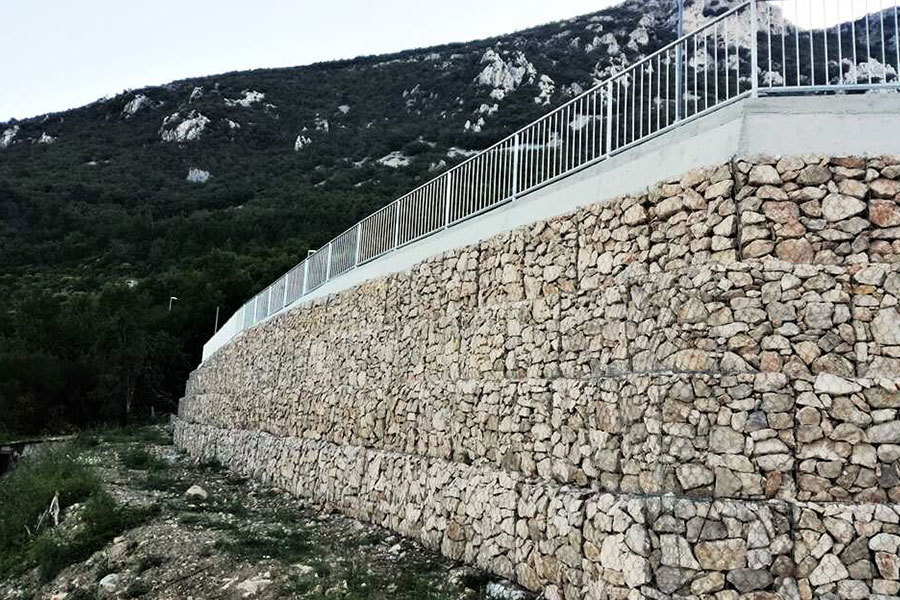
Gabion mesh occupies a distinct niche: double-twisted hexagonal steel mesh wire barrier panels filled with rock, used in erosion control and landscaping. This category sits at the intersection of civil engineering and garden fence panels aesthetics.
Why the coating choice matters as much as the wire type
Three coating systems dominate the 2026 market: Galfan (zinc-5% aluminium alloy), hot-dip galvanized (HDG), and PVC-coated galvanized wire. Hot-dip galvanizing deposits 240–300 g/m² of zinc, achieving tensile strengths of 445–700 MPa depending on wire diameter. Galfan wire provides 2–3× the corrosion resistance of standard HDG at a comparable price point — a fact well known among specification engineers but frequently overlooked by general procurement departments. PVC-coated galvanized wire adds an additional polymer barrier and is favoured in urban environments where aesthetics matter.
"Specifying hot-dip galvanized wire at a minimum zinc coating of 240 g/m² is the baseline for any outdoor installation expected to last beyond ten years in central European climate conditions. Anything below that threshold is false economy."
— DIN EN 10244-2 technical commentary, widely cited in German structural engineering practice
Key specifications you must compare before buying
The single most common procurement error is evaluating mesh wire fencing on price per linear metre without standardising the underlying specification. A 2.0 mm wire fence and a 2.7 mm wire fence can differ by 30% in material cost but by over 200% in service life and load-bearing capacity. The table below standardises the comparison across the parameters that actually drive performance and total cost.

| Specification | Chain link | Welded wire | Woven wire | Gabion mesh |
|---|---|---|---|---|
| Wire diameter (mm) | 2.0 – 3.5 | 2.2 – 4.0 | 2.0 – 3.0 | 4.0 – 6.0 |
| Typical aperture (mm) | 45×45 – 60×60 | 50×50 – 100×100 | 60×80 – 100×120 | 76.2×76.2 |
| Zinc coating (g/m²) | 100 – 300 | 100 – 300 | 240 – 300 | 240 – 300 |
| Tensile strength (MPa) | 345 – 550 | 445 – 700 | 445 – 600 | 445 – 700 |
| Coating options | EG, HDG, PVC, Galfan | EG, HDG, PVC, Galfan | HDG, Galfan | HDG, Galfan |
| Expected service life (years) | 10 – 20 | 15 – 25 | 15 – 30 | 50+ |
| Approx. material cost (€/m²) | 4 – 12 | 8 – 22 | 5 – 15 | 18 – 45 |
| Primary application | General perimeter, sport | Security, industrial | Agriculture, livestock | Civil engineering |
A note on the galvanizing confusion
Why do so many buyers end up with underperforming fences? Because the term "galvanized wire fence" is applied to both electro-galvanized (EG) and hot-dip galvanized (HDG) products — yet their zinc coatings differ by a factor of three to five. EG typically deposits 10–30 g/m²; HDG reaches 240–300 g/m². In a German climate with regular rainfall and road-salt exposure near motorways, an EG steel mesh fence will show surface rust within three to five years. HDG or Galfan-coated alternatives remain structurally sound for fifteen years or more under the same conditions. Always request the zinc coating weight in g/m² on the certificate of conformity, not just the label "galvanized."
Full lifecycle cost analysis: purchase price vs. total cost of ownership
Most supplier quotes focus exclusively on the unit price per panel or per roll. This is, frankly, a misleading basis for comparison. Real decision-making requires a 20-year total cost of ownership (TCO) framework that captures material purchase, fence posts and panels hardware, professional fence installation labour, periodic maintenance, and eventual replacement or recycling.
Based on actual project data from commercial installations across North Rhine-Westphalia and Bavaria, the following TCO comparison illustrates how specification-grade choices affect long-run economics.
| Cost element (per 100 m run) | EG chain link | HDG welded wire | Galfan woven wire |
|---|---|---|---|
| Initial material cost (€) | 1,800 | 3,200 | 2,600 |
| Fence posts + hardware (€) | 1,200 | 1,500 | 1,200 |
| Installation labour (€) | 2,000 | 2,400 | 2,000 |
| 20-year maintenance (€) | 2,500 | 600 | 400 |
| Replacement cycles (20 yr) | 1× full replacement | None expected | None expected |
| 20-year TCO (€) | ~15,000 | ~7,700 | ~6,200 |
The numbers tell a clear story: the cheapest upfront option roughly doubles the 20-year expenditure. Of course, budget constraints are real — there are situations where a shorter planning horizon or a temporary installation genuinely justifies a lower-specification product. Acknowledging that exception is important. But for permanent perimeter fencing or industrial security fencing where continuous integrity is operationally critical, HDG or Galfan specification is simply the rational choice.
Hidden cost: installation complexity
Labour is consistently the most underestimated cost in German fence installation projects. According to recent contractor surveys in the DACH region, professional installation of a welded wire fence panel system on concrete post foundations costs approximately €20–28 per linear metre in labour alone, depending on ground conditions and regional wage rates. Adding post-hole drilling in rocky Bavarian terrain can push that figure to €35+. Factor this into specification decisions early — a panel system that arrives pre-tensioned and pre-cut reduces on-site fitting time significantly compared with roll-based wire netting.
German building regulations and permit requirements
This is the section that most international supplier guides omit entirely — and it is the one German buyers consistently raise in procurement discussions. Fencing in Germany is regulated under Bauordnungsrecht (building code law), which is administered at the federal state (Bundesland) level. The rules vary enough between states that a blanket answer is genuinely impossible.
State-by-state permit thresholds
In Bavaria (Bayern), fences up to 2.0 m in height on residential or agricultural land generally fall under the Verfahrensfreiheit (permit-free) category under Art. 57 BayBO, provided they do not form part of a retaining wall or lie within a flood zone. Industrial security fencing above 2.0 m typically requires a Baugenehmigung (building permit). In North Rhine-Westphalia (NRW), §65 BauO NRW 2018 exempts fences up to 2.0 m on non-street-facing boundaries from permit requirements, but fences along public roads or in designated conservation areas are subject to prior approval regardless of height. Baden-Württemberg applies similar thresholds under §50 LBO BW, with stricter aesthetics-review requirements in protected village (Dorfgebiet) zones. Always verify the current version of your Bundesland's Landesbauordnung and consult your local Baurechtsamt before proceeding with any fence installation above 1.5 m.
Neighbour law and boundary fencing obligations
Germany's Nachbarrechtsgesetze (neighbour law statutes) add a second regulatory layer. In many states, boundary fencing between adjacent plots carries a shared maintenance obligation — meaning both neighbours may have legal rights to demand the fence be maintained or replaced. For agricultural metal wire barriers adjacent to public footpaths, additional liability considerations under §836 BGB (civil liability for structural collapse) apply. Engaging a locally licensed Zaunbauer (fencing contractor) who knows the specific Nachbarrecht of your Bundesland is not optional for commercial installations — it is a risk-management imperative.
Installation guide: step-by-step process and best practices
A correctly installed wire mesh fencing system performs to its rated specification for its full design life. Poor installation is the primary cause of premature fence failure in practice — not material quality. The following process applies to welded wire fence panel systems on steel posts, the most common configuration for commercial and industrial perimeter fencing installations in Germany.
- Site survey and permit confirmation: Verify boundary coordinates, check Bauordnungsrecht permit requirements for your Bundesland, and identify underground utilities using a certified detection service (Leitungsauskunft).
- Post layout and spacing: Mark post positions at 2.0–2.5 m centres for standard 2.0 m panel systems. Corner and gate posts require braced or larger-diameter steel profiles (minimum 60×60×3 mm for spans above 3 m).
- Foundation work: Drill or excavate post holes to a minimum depth of 60 cm (or to below local frost depth, typically 80 cm in central Germany). Set posts in C25/30 concrete; allow 48 hours curing before applying lateral load.
- Panel fitting: Attach welded wire fence panels to posts using purpose-made U-clips or through-bolts at a minimum of three fixing points per panel height. Maintain a ground clearance of 50–100 mm to prevent corrosion from soil contact.
- Tensioning (for roll-based systems): Attach lacing wire (2.0–2.2 mm HDG) at post intervals. Apply tension progressively from one end using a fence stretcher bar; do not over-tension, which can distort the mesh geometry.
- Gate installation: Hang gates on posts set with oversized concrete foundations (minimum 80 cm depth, 30 cm diameter). Check hinge alignment and latch operation before backfilling.
- Final inspection: Check all panel connections, ground clearances, post verticality (±2° tolerance), and any required anti-climb features. Document installation with photographs for warranty and compliance records.
Common installation mistakes to avoid
Real-world inspection data from completed fence projects in Germany's industrial zones reveals three recurring errors. First, posts set too shallow — below 60 cm — fail under wind load within two to three winters, especially on exposed sites. Second, direct steel-to-steel contact between the panel and a plain steel post (without a coating break or separator washer) creates a galvanic cell that accelerates corrosion at the contact point. Third, overlooking the selvedge wire specification: a 3.4 mm selvedge wire on the panel perimeter resists the prying and cutting forces that an intruder or large animal applies, while a 2.0 mm selvedge offers almost no additional resistance over the main mesh wire itself.
Sustainability, recycling certifications, and compliance in Germany
German buyers increasingly apply environmental criteria at the supplier-selection stage — and regulatory pressure is accelerating this trend. The EU Carbon Border Adjustment Mechanism (CBAM), now in its transitional phase, directly affects steel wire products imported from outside the EU. From 2026, importers must report the embedded carbon content of steel mesh products; financial charges will follow from 2027 onwards. This makes the carbon footprint of your wire mesh fencing supply chain a procurement-relevant metric, not just a marketing claim.
Recyclability and Kreislaufwirtschaftsgesetz (KrWG) compliance
Steel wire fence products carry a material recyclability rate of approximately 85–98%, depending on the coating system. Bare HDG steel mesh is accepted without pre-treatment at most German metal recycling facilities (Schrotthandel). PVC-coated wire requires coating removal before recycling and may attract additional handling charges under the Kreislaufwirtschaftsgesetz (German Circular Economy Act, KrWG). When specifying PVC-coated galvanized wire for long-term installations, confirm with your supplier whether the polymer coating can be separated mechanically at end-of-life — this affects both recycling cost and compliance documentation.
ISO 14001 and REACH compliance
For public procurement and larger commercial contracts in Germany, requesting an ISO 14001 environmental management system certificate from your wire mesh supplier is standard practice. Beyond ISO 14001, verify that zinc coating chemicals comply with EU REACH Regulation (EC) No 1907/2006, particularly regarding the use of restricted substances in the galvanizing bath additives. Suppliers shipping from Anping County, Hebei — the world's largest wire mesh manufacturing cluster — vary significantly in their third-party certification status; always request current, unabridged certificates rather than summary declarations.
Choosing a supplier: delivery timescales and local service in the DACH region
Delivery reliability is the factor German procurement managers rank highest after product quality — and it is where many international suppliers underperform. What does the 2026 landscape actually look like for DACH-region buyers?
Typical lead times by sourcing channel
Direct import from Chinese manufacturers (typically Anping-based producers with European distribution agreements) carries a lead time of 25–45 days for standard products held in production stock, rising to 60–75 days for non-standard specifications or custom powder-coat colours. European distributors with DACH warehouse stock — major players include Betafence, Aco Fence, and Carl Stahl — can typically fulfil standard chain link and welded wire orders within 5–10 working days. The trade-off is price: European-stocked products run 15–30% above direct-import pricing on a like-for-like specification basis.
Just how important is this premium? For project managers operating on critical-path schedules, a five-day delivery versus a forty-five-day delivery is not a 30% premium — it is the difference between hitting a handover date and paying liquidated damages. Factor lead time risk into the total cost calculation alongside material prices.
Certifications to request from DACH-region installers
When engaging a local Zaunbauer or fencing subcontractor in Germany, request the following documentation before signing a contract: proof of trade registration (Handelsregistereintrag), liability insurance (Betriebshaftpflichtversicherung) with a minimum coverage of €1.5 million, and references from at least two comparable commercial fence installation projects completed in the same Bundesland within the past three years. For security fencing projects requiring VdS compliance (Verband der Sachversicherer — the German insurers' technical association), confirm that the contractor holds current VdS installation approval for the specific product system specified.
Frequently asked questions
Q: What is the difference between a welded wire fence and a chain link fence?
A: A welded wire fence has resistance-welded intersections forming a rigid square or rectangular grid, offering higher panel stiffness and cut-through resistance. A chain link fence uses interlocked spiral wires creating a flexible diamond pattern that absorbs impact and adapts to uneven terrain. Welded panels suit security and industrial fencing; chain link suits general perimeter and sports applications.
Q: Do I need a building permit to install a fence in Germany?
A: It depends on your federal state (Bundesland) and fence height. In Bavaria and NRW, fences up to 2.0 m on non-street-facing boundaries are generally permit-free. Above 2.0 m, or in protected zones, a Baugenehmigung is required. Always check the current Landesbauordnung for your Bundesland before starting installation.
Q: How long does a galvanized wire fence last in German outdoor conditions?
A: Hot-dip galvanized (HDG) wire fence with 240–300 g/m² zinc coating typically achieves 15–25 years of structural integrity in central European climates. Galfan-coated wire (zinc-5% aluminium alloy) extends this to 25–35 years. Electro-galvanized fencing may show significant corrosion within 5 years in exposed or road-salt-affected locations.
Q: What wire diameter is recommended for livestock fencing in Germany?
A: For cattle and horses, a minimum wire diameter of 2.7 mm with HDG or Galfan coating and an aperture of 80×100 mm or 100×120 mm is standard. For sheep and goats, 2.4 mm wire at 60×80 mm aperture is appropriate. Selvedge wire should be 3.4 mm to resist stretching caused by animal pressure against the fence perimeter.
Q: Are mesh wire fences recyclable under German law?
A: Yes. Bare and HDG-coated steel mesh wire fences are accepted at German Schrotthandel facilities with recyclability rates of 85–98%. PVC-coated galvanized wire requires polymer separation before recycling under the Kreislaufwirtschaftsgesetz (KrWG). Confirm end-of-life handling procedures with your supplier to ensure KrWG compliance before specifying a coating type.
Summary: Selecting mesh wire fences for a project in Germany requires balancing upfront material costs against a 20-year TCO, navigating state-specific Bauordnungsrecht permit requirements, and verifying coating specifications that genuinely match the site's corrosion environment. The 2026 market offers high-performance Galfan and HDG wire mesh fencing solutions that provide significantly lower lifecycle costs than entry-level electro-galvanized products — a distinction that any serious procurement brief should make explicit from the outset. Use the specification table and TCO analysis in this guide as a baseline for your next supplier RFQ.
Get A Quote
Note: Please leave your email address, our professionals will contact you as soon as possible!
Spotlight





Official Website
Hello, What can we do for you?
*Note: Please be sure to fill in the information accurately and keep the communication unblocked. We will contact you as soon as possible


