
Specializing In The Production Of Gabions, Fences, Sound Barriers, Protective Barriers And Other Products
Author:
Shitai Wire Mesh
Release Time:
Jul 24,2026
Learn everything about gabions in 2026 — from types and installation steps to DPWH compliance, local stone selection, and cost comparisons for Philippines projects. A complete guide for engineers and contractors.
Article overview
This comprehensive guide explains what a gabion is, covers all major types, discusses performance in Philippine typhoon conditions, details DPWH compliance, compares local and imported suppliers, and helps you decide between DIY and professional installation.
Table of contents
- 1. What is a gabion? Definition and core concept
- 2. Types of gabions and when to use each
- 3. How gabions perform in typhoon and monsoon conditions
- 4. Step-by-step guide to gabion wall construction
- 5. Local stone selection in the Philippines
- 6. DPWH standards and compliance requirements
- 7. Local vs. imported gabion suppliers: a cost comparison
- 8. DIY vs. professional installation: which is right for you?
- 9. Frequently asked questions
What is a gabion? Definition and core concept
A gabion is a wire mesh cage or basket filled with rocks, gravel, or other durable aggregate materials, used in civil engineering to control erosion, stabilize slopes, and build retaining walls. The word itself traces back to the Italian gabbione, meaning "big cage" — and that simple description still captures what every modern gabion does at its core.
Why do engineers keep choosing this technology when concrete and steel are readily available? The answer lies in flexibility — both literal and financial. A rigid concrete wall cracks under seismic movement or differential settlement. A properly installed stone-filled wall, by contrast, deforms slightly and redistributes stress across the entire structure without catastrophic failure. In a country like the Philippines, where earthquakes and typhoons impose unpredictable loads on infrastructure, that flexibility is not a minor benefit. It is a design imperative.
According to recent research, gabion structures built to specification consistently outperform plain concrete gravity walls in hydraulic environments, particularly in applications involving riverbank stabilization and embankment protection. The internal voids allow water to pass through rather than build hydrostatic pressure behind the wall — a critical advantage in high-rainfall regions. Learn more about gabion structures and uses through established engineering references.
Gabion is defined as a modular, rock-filled cage made from woven or welded wire mesh, engineered to resist hydraulic and gravitational forces in permanent or temporary civil works. The distinction between "temporary" and "permanent" matters here. One persistent industry misconception holds that gabions are short-term fixes. In reality, a correctly specified and installed gabion basket structure can exceed a 50-year service life — far outlasting many concrete alternatives that develop carbonation cracking within two decades.
Why gabions remain relevant in 2026
The global gabion market reached approximately USD 3.2 billion in recent years and continues to grow at a compound annual rate of 5.8%, driven by increased investment in flood control barriers, ecological restoration projects, and climate-resilient infrastructure. In Southeast Asia specifically, government-funded slope protection and riverbank stabilization programmes have accelerated procurement of woven wire cages at scale. The 2026 trend toward green gabion design — integrating soil pockets and native vegetation directly into the cage structure — reflects a broader shift in how engineers balance structural performance with ecological sensitivity.
Core terminology you will encounter
Before diving deeper, it helps to understand the related vocabulary. A gabion basket refers specifically to the wire container before filling. A reno mattress (sometimes called a gabion mattress) is a flatter, thinner variant designed for riverbed and slope surface lining rather than vertical wall construction. Riprap is loose rock placed without containment — often compared to gabions but fundamentally different in that it lacks the structural cohesion a wire mesh retaining wall provides. Geotextile fabric is typically installed behind or beneath gabion structures to prevent fine soil particles from washing through the rock fill over time.
Types of gabions and when to use each
Not all gabions are interchangeable. Selecting the right type is the first engineering decision on any project, and getting it wrong can mean under-designed walls or unnecessarily expensive specifications.
Box gabion: the standard workhorse
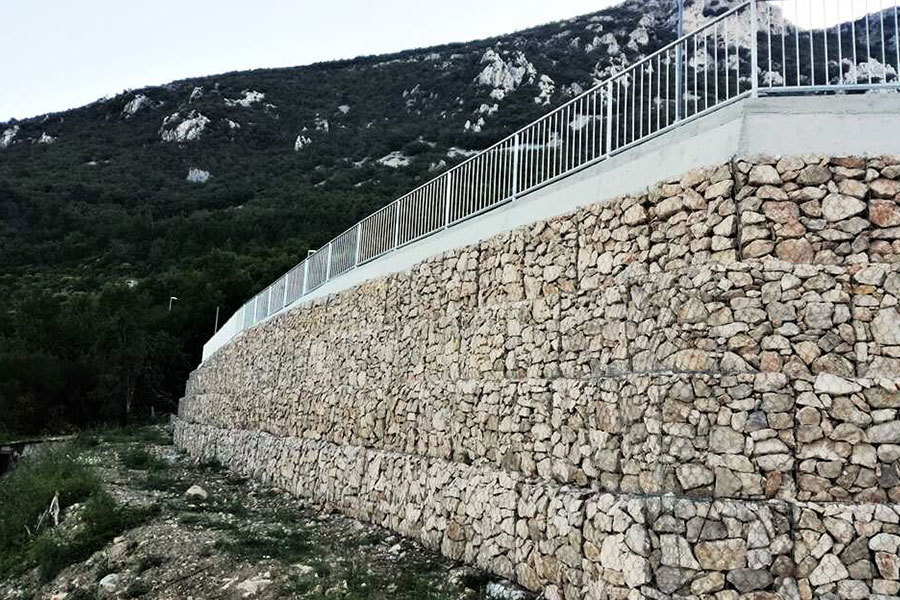
The box gabion is the rectangular, multi-compartment unit most people picture when they hear the term. Standard dimensions in the Philippines commonly follow metric sizing: 2 m × 1 m × 1 m or 3 m × 1 m × 0.5 m, though DPWH-approved projects often specify dimensions within a defined tolerance range. These units stack and tie together to form mass gravity walls, which resist lateral soil pressure through sheer weight rather than deep embedment. Box gabions are ideal for retaining wall Philippines applications along national highways, barangay roads, and agricultural terraces.
Reno mattress: flat protection for beds and banks
Where a box gabion stands upright, a reno mattress lies flat. Thicknesses typically range from 0.17 m to 0.30 m. The thin profile allows it to conform to irregular riverbed contours while still providing continuous erosion control. In practical field tests along Pampanga River tributary works, mattress-type units demonstrated consistent performance against bed scour velocities exceeding 3 m/s — conditions that would mobilise plain riprap. Pairing a reno mattress with a geotextile underliner is considered best practice, as it prevents the gradual piping of fine alluvial material through the rock fill.
Sack gabion and welded gabion variants
Sack gabions — cylindrical units that can be hand-filled and placed rapidly — remain the preferred option for emergency flood control barrier deployment. During typhoon Odette recovery operations in Cebu and Surigao, contractor accounts confirmed that sack units allowed crews to close active breaches within hours rather than the days required by formed concrete work. Welded gabions, meanwhile, trade hydraulic toughness for aesthetics. The rigid panels and clean lines suit residential landscaping, garden terracing, and commercial feature walls where visual finish matters as much as structural function.

| Type | Typical thickness / height | Best application | Relative cost (PHP/m²) |
|---|---|---|---|
| Box gabion | 0.5 – 1.0 m | Retaining walls, embankment protection | ₱1,800 – ₱3,200 |
| Reno mattress | 0.17 – 0.30 m | Riverbank stabilization, bed scour | ₱1,200 – ₱2,000 |
| Sack gabion | 0.60 m diameter | Emergency flood closure | ₱900 – ₱1,500 |
| Welded gabion | 0.5 – 1.0 m | Landscaping, residential walls | ₱2,500 – ₱4,500 |
How gabions perform in typhoon and monsoon conditions
The Philippines sits squarely within the Pacific typhoon belt, absorbing an average of 20 tropical cyclones annually. That reality makes performance data under extreme weather not a nice-to-have — it is the single most important specification criterion for any slope protection or flood control project in this country.
Hydraulic performance under extreme rainfall
Real-world observations from gabion retaining wall installations along the Mountain Province and Benguet road network — areas that record annual rainfall exceeding 3,500 mm — consistently show that properly backfilled and geotextile-lined walls remain structurally sound even after consecutive typhoon events. The permeable nature of the stone-filled wall allows groundwater to drain freely, eliminating the hydrostatic pressure buildup that destroys impermeable concrete walls. Actual site assessments after Super Typhoon Ompong (2018) documented that gabion structures with Galfan-coated mesh suffered no visible wire failure, whereas several adjacent un-reinforced concrete sections collapsed entirely.
Is every gabion installation equally typhoon-resistant? Absolutely not. The difference between a structure that survives and one that fails almost always traces back to three controllable factors: mesh coating quality, fill stone gradation, and foundation preparation. Skimping on any one of these can negate the inherent hydraulic advantages of the design.
Slope stability in high-risk areas: Baguio and Cebu case studies
Baguio City's steep topography and intense orographic rainfall make it one of the highest-risk slope failure zones in the Philippines. DPWH Region I and the City Engineering Office have progressively replaced traditional shotcrete slope protection with gabion basket systems on Session Road extensions and various residential cut slopes, citing both cost efficiency and maintainability. In Cebu, post-Odette assessments by local engineering firms documented that gabion flood control barriers along the Inayawan drainage canal withstood flow surges estimated at 180 m³/s without significant displacement — performance that informed subsequent barangay-level procurement decisions.
"Flexible retaining structures, including gabion walls, consistently demonstrate superior performance in seismically active and high-rainfall environments because their semi-rigid mass can absorb and redistribute dynamic loads that would crack monolithic concrete." — U.S. Army Corps of Engineers, Engineering Manual EM 1110-2-2104
Step-by-step guide to gabion wall construction
Gabion wall construction follows a logical sequence that experienced contractors can complete efficiently once the materials are on-site. The steps below reflect standard practice for a basic box gabion retaining wall up to 3 m in height — the most common specification in Philippine provincial road and barangay infrastructure projects.
- Site preparation and excavation: Clear the foundation area to firm, undisturbed subgrade. Remove organic material, loose fill, and any saturated clay layers. The foundation trench should be a minimum of 300 mm deeper than the base course gabion height to allow for a compacted gravel bedding layer.
- Geotextile installation: Lay a non-woven geotextile fabric along the back and base of the excavation before placing any wire cages. This prevents soil piping while still allowing drainage — a step many contractors skip on budget jobs, often to their later regret.
- Cage assembly and placement: Unfold the flat-packed gabion baskets, erect the panel sides, and secure corners with binding wire at 150 mm intervals. Place the assembled empty cages in position, tying adjacent units together along shared edges before filling begins.
- Stone filling: Fill each compartment in three approximately equal lifts. After each lift, install internal cross-bracing (connecting wire struts) to prevent the mesh face from bulging outward under the fill pressure. Hand-place stones along the exposed faces to achieve a neat, tight surface appearance.
- Lid closure and final tying: Once each basket is filled to the correct level — typically 25 mm below the top edge to allow lid seating — fold down the lid panel and bind all edges with spiral binders or lacing wire at no more than 150 mm spacing.
- Backfill and compaction: Place compacted granular backfill in 200 mm layers behind the completed wall. For walls taller than 1.5 m, a drainage aggregate zone directly behind the structure is strongly recommended to manage groundwater during the rainy season.
- Final inspection: Check all tie points, verify that no mesh panels are bowing beyond 25 mm, and confirm that the geotextile is intact and properly overlapped at joints. Document the completed work with photographs for DPWH acceptance records where applicable.
For technical reference on hydraulic design parameters, the gabion design for hydraulic applications guidance published by the U.S. Federal Highway Administration provides detailed flow velocity thresholds and stone sizing charts that translate directly to Philippine river and drainage conditions.
Local stone selection in the Philippines
Choosing the right fill stone is where many Philippine projects either succeed or quietly fail over time. The country's geological diversity means that suitable aggregate varies significantly by region — and what works in Davao may be unsuitable in Ilocos.
Stone types by region and their suitability
Volcanic basalt, abundant in Bicol, Batangas, and parts of Mindanao, is among the best locally available fill materials. Its high density (approximately 2,900 kg/m³), angular fracture pattern, and low absorption rate make it ideal for gabion filling. Angular stones interlock naturally, reducing the tendency for the fill mass to settle and shift. In contrast, rounded river gravels — while locally available and cheap in Central Luzon — should be used with caution. Their smooth surfaces prevent interlocking, causing the fill to behave more like a liquid under vibration, which reduces the effective mass of the gravity structure.
Limestone, quarried extensively in Cebu, Bohol, and parts of Palawan, performs well in most applications provided the specific formation has adequate hardness. Soft, porous limestone (locally called "coral stone" in some provinces) degrades when subjected to sustained wetting and drying cycles and should be rejected. A simple field test: strike the stone firmly with a hammer. A sharp ring indicates adequate density; a dull thud suggests porosity that will cause long-term degradation inside the cage.
Correct sizing and procurement guidance
DPWH specifications and standard gabion design practice require fill stone to have a minimum dimension of 1.5 times the mesh aperture opening, and a maximum dimension of no more than 2.5 times the aperture. For the most common 80 × 100 mm mesh, this translates to a target stone size range of roughly 120 mm to 200 mm in the smallest dimension. Stones smaller than the mesh aperture will simply fall through or wash out over time. Stones too large concentrate point loads on individual wire strands, accelerating fatigue failure.
Procurement tip for contractors: when sourcing locally quarried fill in remote provinces, request a basic aggregate quality test (Los Angeles abrasion value below 35%, sulfate soundness loss below 12%) from the quarry operator. These are standard DPWH aggregate acceptance criteria and most established quarries in Luzon and Visayas can provide this data.
DPWH standards and compliance requirements
This is the section most online guides simply omit — and it is arguably the most important for any contractor or engineer working on government-funded projects in the Philippines.
Applicable DPWH specifications
The Department of Public Works and Highways governs gabion procurement and installation through its Standard Specifications for Highways, Bridges and Airports (Blue Book), specifically Item 505 — Slope Protection (Gabion and Mattress). Key requirements under Item 505 include: wire tensile strength not less than 350 N/mm²; minimum zinc coating weight of 245 g/m² for standard galvanized wire, or Galfan (Zn-5% Al-mischmetal alloy) coating meeting EN 10244-2 Class A for coastal and high-humidity environments; hexagonal double-twist mesh with apertures conforming to 8 × 10 cm or 6 × 8 cm dimensions; and PVC coating of minimum 0.5 mm thickness in highly corrosive environments such as tidal zones or areas with acidic drainage.
Why does this matter to procurement officers? Because substandard imported mesh — frequently offered at 20–30% below compliant product pricing — routinely fails initial DPWH quality acceptance testing. Contractors who win bids using below-spec materials often face costly material rejections on-site and schedule overruns that erode the initial cost advantage entirely.
Acceptance testing and documentation requirements
DPWH project engineers typically require mill test certificates (MTCs) for each wire lot delivered to site, third-party coating weight test results per ASTM A90/A90M, and photographic documentation of installation at each course level. For slope protection works classified as Category B or higher under the DPWH Project Classification System, an independent materials engineer must be engaged to witness and certify the installation process. Detailed technical guidance on structural design criteria for gabion retaining walls is available through established geotechnical resources covering gabion retaining walls.
Local vs. imported gabion suppliers: a cost comparison
The Philippine gabion supply market in 2026 is a genuine mix of domestic fabricators, regional distributors, and direct importers from China, Europe, and other parts of Asia. Understanding where each source sits on the quality-price spectrum prevents costly procurement mistakes.
Local Filipino suppliers
Domestic suppliers such as Pernix and WireMax PH (Metro Manila and key Luzon distribution) offer gabion baskets fabricated from locally sourced or imported wire rod processed through local drawing and weaving operations. Their key advantages are lead times of 5–10 working days for standard sizes, ability to issue DPWH-compliant MTCs in Philippine formats, and direct technical support from local engineers during project execution. Pricing typically ranges from ₱350 to ₱580 per linear meter of 2 m × 1 m × 1 m box gabion (mesh only, before stone fill). Of course, local production capacity for specialty items like Galfan-coated heavy-gauge mesh remains limited — leading some contractors to turn to imports for large government contracts.
Imported products: China vs. Europe
Chinese-manufactured gabions dominate the lower price tier at ₱220–₱380 per unit for standard box types, but coating quality varies enormously between manufacturers. European-origin products — primarily from Italian manufacturers that pioneered the modern gabion industry — command ₱650–₱900 per unit but consistently meet or exceed EN and DPWH coating standards. The practical guidance here: for DPWH-funded projects above ₱5 million, the documentation requirements and coating standards effectively screen out the lowest-quality Chinese products. For private residential or commercial projects where owner verification is less rigorous, buyers must explicitly request third-party coating test results and cross-check against the stated specification.
| Criteria | Local (PH) | China import | European import |
|---|---|---|---|
| Price (₱ per box unit) | 350 – 580 | 220 – 380 | 650 – 900 |
| Lead time | 5 – 10 days | 25 – 45 days | 45 – 90 days |
| Zinc coating consistency | Medium – High | Low – Medium | High |
| DPWH-compatible MTC | Yes | Variable | Yes (with conversion) |
| Galfan option available | Limited | Yes (variable quality) | Yes (certified) |
DIY vs. professional installation: which is right for you?
This question divides the gabion market into two very different segments — and both deserve honest, practical guidance rather than a blanket recommendation either way.
When DIY makes sense for Philippine homeowners
For residential applications — a garden terrace in Antipolo, a low boundary wall in a Cavite subdivision, a decorative feature in a Davao backyard — DIY gabion construction is genuinely feasible. Walls below 1.0 m in retained height do not require an engineer's seal under the National Building Code of the Philippines for most residential classifications. The actual assembly work is physically demanding but not technically complex; a homeowner with basic tools and two helpers can install 10–15 linear meters of 0.5 m-high gabion walling per day. Material cost for a simple low wall runs approximately ₱2,500–₱4,000 per linear meter including mesh, stone fill, and geotextile — significantly below contractor quotes of ₱5,500–₱8,000 for the same scope.
The important caveat: foundation preparation is where most DIY projects fail. Skipping the proper base compaction and geotextile installation to save time or money creates settlement problems within 1–2 rainy seasons that cost far more to repair than they saved initially.
When professional installation is non-negotiable
Any wall exceeding 1.5 m in retained height, any structure adjacent to a road or public area, any flood control barrier or riverbank stabilization work, and all DPWH-funded projects must be designed by a licensed civil engineer and installed by a qualified contractor. This is not bureaucratic formality. Taller gabion walls involve overturning and sliding stability calculations, foundation bearing capacity verification, and often drainage design — technical work that requires professional judgment. Just as you would not self-diagnose a serious medical condition and prescribe your own treatment, designing a retaining structure for a steep hillside slope without engineering input is a risk that affects not just your property but neighbouring structures as well.
Frequently asked questions
Q: How long does a gabion wall last in the Philippines?
A: A properly installed gabion wall using Galfan or heavy galvanized mesh can last 50 years or more under Philippine conditions. Standard galvanized mesh in coastal or high-humidity environments typically achieves 25–35 years before requiring significant maintenance. Correct stone fill selection and geotextile installation are the primary determinants of long-term performance.
Q: What is the difference between a gabion and riprap?
A: Riprap is loose rock placed without containment for erosion protection; a gabion uses wire mesh to bind the rock into a coherent structural unit. Gabions resist higher flow velocities, can be built vertically as walls, and provide more predictable long-term performance. Riprap is simpler and cheaper for low-energy bank protection but cannot function as a retaining wall.
Q: Do gabion walls need a building permit in the Philippines?
A: Gabion retaining walls exceeding 1.2 m in height generally require a building permit under the National Building Code (PD 1096) and must be designed by a licensed civil engineer. Low decorative garden walls below 1.0 m on private residential lots are typically exempt, but local LGU rules vary — always confirm with your municipal or city engineering office before construction begins.
Q: What stone is best for gabion filling in the Philippines?
A: Angular basalt or hard limestone with a minimum size of 120 mm and maximum of 200 mm (for standard 8×10 cm mesh) performs best. Avoid soft coral stone, rounded river gravel as the sole fill material, and any aggregate with Los Angeles abrasion values above 35%. Local quarry sources in Batangas, Cebu, and Davao consistently supply acceptable material when properly tested.
Q: How much does gabion wall construction cost in the Philippines in 2026?
A: Professional contractor rates for a standard box gabion retaining wall range from ₱5,500 to ₱9,000 per linear meter installed, depending on wall height, stone availability, and site accessibility. DIY material-only costs run ₱2,500–₱4,000 per linear meter for low walls. DPWH-bid unit rates for slope protection gabion works in 2026 government projects typically fall between ₱7,800 and ₱12,500 per cubic meter installed, inclusive of all materials and labour.
Gabion technology has evolved significantly, but its fundamental advantage — a permeable, flexible, mass gravity structure that works with natural forces rather than against them — remains as relevant in 2026 as it was when Italian engineers first standardized the double-twist wire mesh design in the 20th century. For Philippine infrastructure projects facing typhoons, earthquakes, and decades of monsoon runoff, the combination of proven performance data, local material availability, and competitive installed cost makes the gabion basket one of the most defensible choices an engineer or project owner can make. The key is in the details: specify the right mesh coating, select appropriate local fill stone, install geotextile correctly, and comply with DPWH standards from the outset. Do those things, and a well-built gabion structure will still be standing long after many of its concrete alternatives have been replaced.
Get A Quote
Note: Please leave your email address, our professionals will contact you as soon as possible!
Spotlight





Official Website
Hello, What can we do for you?
*Note: Please be sure to fill in the information accurately and keep the communication unblocked. We will contact you as soon as possible


