
Specializing In The Production Of Gabions, Fences, Sound Barriers, Protective Barriers And Other Products
Author:
Shitai Wire Mesh
Release Time:
Jul 22,2026
A complete 2026 guide to gabion retaining walls in the Philippines — covering design, installation steps, local stone costs in Philippine Peso, typhoon-season drainage, DPWH compliance, LGU permits, and DIY vs. contractor comparisons.
Article overview
This guide explains how gabion retaining walls work, what they cost in the Philippines, how to install them correctly, and how to comply with DPWH and local government requirements. It is written for engineers, project owners, and contractors who are currently evaluating slope protection options and need locally relevant, technically grounded information.
Table of contents
- 1. What are gabion retaining walls?
- 2. Types of gabion walls and which one suits your project
- 3. Gabion wall design: drainage, seismic, and DPWH compliance in the Philippines
- 4. Local materials and cost breakdown in the Philippines (2026)
- 5. Step-by-step gabion box installation guide
- 6. DIY vs. contractor: pros, cons, and Philippine labor cost estimates
- 7. Real project applications in the Philippines
- 8. Frequently asked questions
What are gabion retaining walls?
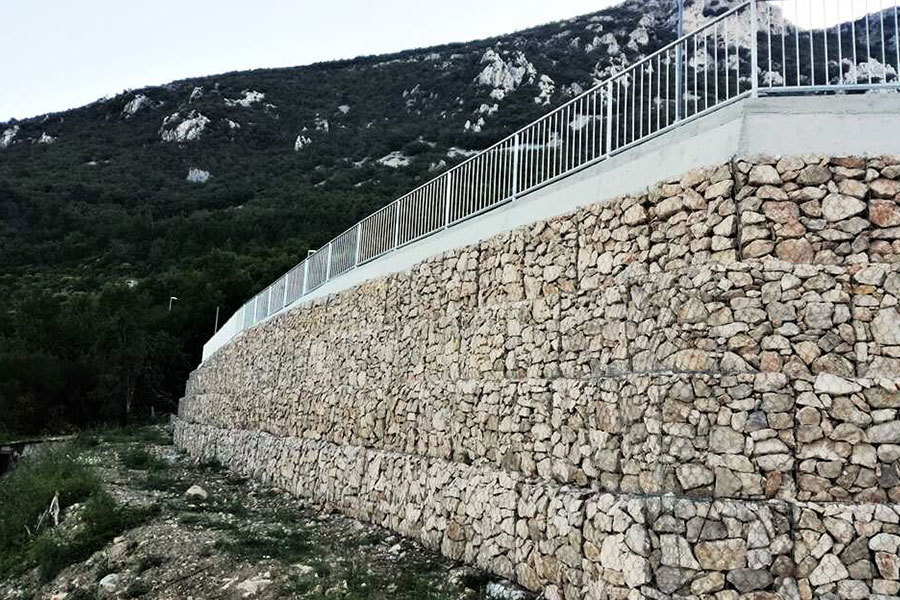
Gabion retaining walls are rock-filled wire mesh basket structures stacked to form a gravity retaining wall that resists soil pressure through sheer mass and flexible interlocking. Unlike rigid concrete walls, a gabion system tolerates slight ground movement without cracking — a critical advantage in the Philippines, where seismic activity and saturated hillside soils are constant engineering realities.
The word "gabion" comes from the Italian gabbione, meaning "large cage." At their core, these structures are elegantly simple: you fill a woven wire gabion cage with angular stone, close it, and stack additional units until the desired wall height is achieved. The stone basket wall gains its structural integrity not from a single monolithic pour but from thousands of individual contact points between stones — much like how a dry-stone wall achieves stability through careful arrangement rather than mortar.
For a broader technical overview, refer to this gabion retaining walls overview from Wikipedia, which documents the historical and engineering context of gabion systems worldwide.
Why gabion walls are widely used in the Philippines
The Philippines presents a near-perfect set of conditions for gabion wall adoption. Roughly 70% of the country's land area is hilly or mountainous, annual rainfall frequently exceeds 2,500mm in many provinces, and the archipelago sits along the Pacific Ring of Fire. All three factors — steep terrain, heavy precipitation, and seismic exposure — favor a flexible retaining system over a brittle one. Actual site work in provinces like Benguet, Mountain Province, and Bukidnon consistently shows that concrete walls crack and heave within five to ten years on unstable hillsides, while gabion structures absorb differential settlement and continue performing.
Key structural principle: gravity and permeability working together
A gabion retaining wall functions as a gravity retaining wall: its weight — typically between 1,600 and 2,000 kg per cubic meter when filled with dense quarry stone — counteracts the lateral earth pressure behind it. What makes it distinctly different from a concrete gravity wall is permeability. Water passes freely through the fill, preventing the hydrostatic pressure buildup that is the single most common cause of retaining wall failure. This built-in drainage characteristic is not an incidental benefit; it is a core engineering feature that directly addresses the soil erosion prevention challenge during Philippine typhoon season.
Types of gabion walls and which one suits your project
Not all gabion products are interchangeable. The right selection depends on your site geometry, hydraulic loading, aesthetic requirements, and budget. The five main types used in Philippine construction projects each occupy a distinct engineering niche.
Box gabion (standard cage unit)
The standard box gabion — typically 2m × 1m × 1m or 3m × 1m × 1m — is the workhorse of slope stabilization wall projects. Its modular format makes it easy to step-back terraced retaining wall configurations on hillside lots. Most DPWH road protection projects in the Cordillera and Cagayan Valley use this type. For walls exceeding 3 meters in height, these boxes are stacked with a batter (backward lean) of 1:6 to 1:10 to improve overturning resistance.
Gabion mattress (Reno mattress)
Gabion mattresses are flat, thin units — typically 0.17m to 0.30m thick — laid horizontally over river banks, channel beds, and coastal slopes. They are the correct product for erosion control wall applications along river embankments and shoreline revetments. A number of municipal flood-control projects in Pampanga and Davao del Sur have used Reno mattresses to armor channel banks against typhoon-season peak flows.
Welded mesh gabion and other variants
Welded mesh gabions offer a cleaner, more geometric face profile preferred for urban landscape walls, commercial property boundary walls, and resort-area rockfall protection barrier installations. They are stiffer than woven wire gabion units, which means they are less tolerant of differential settlement — an important caveat on soft or variable soils. Vegetated gabions, which combine a soil-filled upper layer with geotextile backing to support plant growth, are increasingly specified for eco-sensitive projects under DENR permitting requirements.

| Gabion type | Best application | Typical unit cost (PHP/m²) | Settlement tolerance |
|---|---|---|---|
| Box gabion (woven) | Slope retention, road cuts | ₱2,800 – ₱4,500 | High |
| Gabion mattress | River bank, channel lining | ₱1,900 – ₱3,200 | High |
| Welded mesh gabion | Landscape walls, urban sites | ₱3,500 – ₱6,000 | Moderate |
| Vegetated gabion | Eco-sensitive, DENR-permitted | ₱4,200 – ₱7,500 | High |
| Sack gabion | Emergency underwater works | ₱1,500 – ₱2,800 | Very high |
*2026 indicative supply prices in Philippine Peso, exclusive of fill stone and installation labor. Prices vary by province and supplier volume.
Gabion wall design: drainage, seismic, and DPWH compliance in the Philippines
Proper gabion wall design in the Philippines must address three concurrent engineering demands: typhoon-season hydraulic loading, seismic zone requirements, and DPWH regulatory standards. Ignoring any one of these three factors is the most common reason gabion projects fail or fail to obtain permits.
Designing for typhoon-season drainage
During a Philippine typhoon, 24-hour rainfall can exceed 400mm in exposed coastal and upland areas. A gabion wall's natural permeability helps, but it is not sufficient on its own. Behind every wall taller than 1.5 meters, a gravel drainage blanket (minimum 300mm thick, D50 ≥ 50mm) should be placed between the retained soil and the rear face of the gabion. Perforated PVC pipes (100mm diameter, sloped at 1–2% toward outlets) embedded at the base of the drainage layer further accelerate groundwater evacuation. Without this system, saturated backfill significantly increases lateral earth pressure — sometimes doubling the design load during a sustained rainfall event. Real-world monitoring on a slope stabilization wall project in Quirino Province showed that drainage layer installation reduced pore water pressure behind the wall by approximately 60% during peak wet-season conditions.
Seismic design for Zone 4 and Zone 5 areas
Most of Luzon, the Visayas, and Mindanao fall within Philippine seismic Zone 4 or Zone 5 under the National Structural Code of the Philippines (NSCP 2015). For gabion retaining walls in these zones, the horizontal seismic coefficient used in stability analysis is typically 0.20g to 0.40g depending on site classification. Walls higher than 3 meters in Zone 4/5 areas must be analyzed for sliding, overturning, and bearing capacity under combined static and seismic loading. The Mononobe-Okabe method is the standard approach for computing seismic earth pressure on flexible retaining systems. For detailed guidance on design methodology, the gabion wall design and applications resource from GeoEngineer provides a solid technical foundation. Stepped-back, battered gabion configurations perform significantly better under seismic loading than vertical walls because the geometry lowers the center of gravity and increases base width.
DPWH compliance and LGU permit requirements
Projects funded or co-funded by DPWH must comply with the DPWH Standard Specifications for Highways, Bridges, and Airports (Blue Book), Item 505 (Grouted Riprap) and Item 506 (Gabions and Mattresses). For private developments, the LGU (Local Government Unit) building permit process is the primary regulatory pathway. The typical LGU application for a retaining wall structure includes: (1) accomplished building permit application form, (2) site development plan signed by a licensed civil engineer or geodetic engineer, (3) structural design calculations and drawings stamped by a licensed structural engineer, (4) soil investigation report for walls exceeding 2 meters in height or located on slopes steeper than 30°, and (5) barangay clearance. Processing time varies widely — from two weeks in well-staffed city engineering offices to three months in rural municipalities. A common approval delay is the absence of a proper drainage plan; reviewers in Benguet and Mountain Province LGUs specifically flag this as a frequent deficiency in submitted plans. Of course, some barangays have additional localized requirements, so always confirm with the municipal engineer's office before finalizing your submission package.
"Flexible retaining systems such as gabion walls, when properly designed with adequate drainage provisions, demonstrate superior performance under both seismic and hydraulic loading compared to rigid concrete structures — particularly in environments subject to differential settlement and high groundwater variability." — retaining wall systems technical guidance, U.S. Federal Highway Administration
Local materials and cost breakdown in the Philippines (2026)
One area where nearly every competing online guide falls short is concrete, locally grounded cost data. Here are 2026 reference figures based on actual procurement in Luzon, Visayas, and Mindanao markets.
Local stone procurement: riprap and quarry stone
The fill material is usually the single largest cost component. For gabion box installation, angular quarry stone with a particle size of 75–200mm is the standard specification. Soft limestone and easily weathered rock must be rejected — a point worth emphasizing because some local quarries in Cebu and Bohol supply coral stone or soft calcareous rock that looks structurally sound but degrades within three to five years when repeatedly wetted and dried.
2026 indicative stone prices by region (delivered to site, per cubic meter):
- Metro Manila / Cavite / Laguna: ₱1,200 – ₱1,800/m³ (andesite or basalt riprap from Quezon / Bulacan quarries)
- Benguet / Mountain Province: ₱800 – ₱1,200/m³ (local granite/diorite; hauling cost dominates)
- Cebu / Central Visayas: ₱950 – ₱1,500/m³ (hard limestone; verify compressive strength ≥ 35 MPa before accepting)
- Davao / Northern Mindanao: ₱900 – ₱1,400/m³ (basaltic riprap widely available)
Total gabion wall cost per square meter (supply + install)
Based on recent project data, a fully installed box gabion wall in the Philippines (1m thick, standard woven wire mesh, local quarry stone fill, drainage layer included) ranges from approximately ₱5,500 to ₱9,000 per square meter of wall face, depending on wall height, site accessibility, and stone haulage distance. This compares to ₱9,000–₱15,000/m² for a reinforced concrete retaining wall of equivalent capacity — confirming the industry consensus that gabion construction delivers 30–50% cost savings versus concrete, as documented in Maccaferri's technical literature.
Why does this matter? For a typical 50-linear-meter hillside protection project at 2 meters average height, the gabion option saves roughly ₱300,000–₱600,000 compared to cast-in-place concrete. That is a meaningful figure for private landowners and municipal governments operating under tight infrastructure budgets.
Step-by-step gabion box installation guide
Following the correct sequence matters enormously. Skipping or shortcutting any of the first three steps accounts for the majority of premature gabion wall failures observed in Philippine field inspections.
- Site preparation and excavation: Strip topsoil and organic material from the foundation area. Excavate to firm subgrade — typically 300–500mm below finished ground level for walls up to 3m. On soft or saturated ground, place a 200mm compacted crushed gravel sub-base (DPWH Item 200 material or equivalent).
- Geotextile liner installation: Lay a non-woven geotextile (minimum 200 g/m²) on the leveled subgrade and up the back face of the excavation. This prevents fine soil particles from migrating into the stone fill — a process called "piping" that progressively weakens the wall base.
- First-layer cage assembly and positioning: Unfold the woven wire gabion cages on a flat surface, erect the panels, and fasten all adjacent edges with lacing wire at 100mm intervals or approved helical connectors. Position the assembled boxes on the prepared foundation and check for level and alignment.
- Stone filling: Fill cages in maximum 300mm lifts to prevent bulging of the wire panels. Use a mechanical tamper or hand-pack stone at the exposed face to achieve a tight, presentable surface. Internal cross-bracing ties (diaphragm wires) must be installed at the mid-height of each 1m-tall cage as specified by the manufacturer.
- Drainage layer placement: Backfill behind the completed first row with a graded gravel drainage blanket (300mm minimum thickness) before placing retained soil. Install the perforated drainage pipe at this stage.
- Subsequent layer stacking: Repeat the assembly, filling, and drainage sequence for each additional course. Introduce a batter setback of 50–100mm per layer (tilting slightly into the hillside) for walls above 2m.
- Lid closure and final lacing: Close and lace the top lids of all cages securely. Apply a final layer of smaller angular stone (25–50mm) to the top surface to deter vandalism and improve appearance.
- Vegetation and site reinstatement: Seed or turf the area behind and above the wall immediately after completion to reduce surface runoff velocity and minimize post-construction erosion.
One question worth asking before you start: have you verified the wire mesh specification? Many low-cost gabion products sold through Lazada or local hardware distributors use mesh wire of only 2.0mm diameter, which is insufficient for permanent structural walls. DPWH Item 506 requires a minimum wire diameter of 2.7mm (woven) or 3.0mm (welded) for structural gabion applications.
DIY vs. contractor: pros, cons, and Philippine labor cost estimates
DIY gabion installation is genuinely feasible for low walls (under 1.5m) on private residential lots where engineering sign-off is not required. The material is not dangerous to handle, the assembly sequence is logical, and the work proceeds at whatever pace the owner sets. That said, common DIY errors observed in Philippine residential projects include insufficient foundation depth, omitted drainage layers, incorrect stone size (too small — stones smaller than 75mm slip through standard mesh apertures), and inadequate lacing wire tension leading to cage bulge.
Philippine labor cost estimates (2026)
For contractor-built projects, unskilled labor (mason's helper, stone packer) in the Philippines earns approximately ₱550–₱750 per day outside Metro Manila, and ₱750–₱950 per day within Metro Manila and Cebu City, based on 2026 DOLE regional minimum wage orders. A two-person crew can install roughly 3–5 linear meters of 1m × 1m box gabion wall per day on an accessible site. Skilled site supervisors (foreman level) command ₱1,200–₱1,800/day. Budget a labor-only cost of approximately ₱1,500–₱2,500 per square meter of wall face for standard contractor installation.
When to hire a licensed engineer and contractor
Any wall exceeding 1.5 meters in height, any wall adjacent to a road or public right-of-way, any wall on a slope steeper than 20°, or any project in a declared hazard zone requires a licensed civil or structural engineer's involvement — both for design safety and for LGU permit compliance. The engineering fee for a standard slope protection design typically runs ₱20,000–₱60,000 depending on project complexity and the engineer's location, which is a modest investment relative to total project cost and personal liability exposure.
Real project applications in the Philippines
Gabion retaining walls in the Philippines appear across a wide range of terrain types and project scales. The following cases illustrate the versatility of this soil erosion prevention technology in local conditions.
Hillside residential and agricultural terracing (Cordillera and Bukidnon)
In Benguet, a private landowner stabilized a 120-linear-meter cut slope on a 35° incline using three-tier terraced retaining walls with 2m-high box gabions at each level. Total project cost was approximately ₱1.4 million, including local granite fill sourced 8km from the site. The terracing also created usable flat land for vegetable farming — turning a slope protection necessity into a productive land development outcome. After three typhoon seasons (including one Typhoon Signal No. 3 event), the wall showed no measurable displacement.
Coastal erosion control (Eastern Samar and Davao del Sur)
Coastal gabion mattress installations along Eastern Samar shorelines — particularly in areas affected by Typhoon Yolanda's wave surge damage — have served as rockfall protection barriers and shoreline stabilization structures simultaneously. A 200-meter revetment project in Guiuan, Eastern Samar used double-layer gabion mattresses (300mm each) to armor a coastal road embankment. Project cost was approximately ₱3.2 million. The flexible retaining system absorbed wave energy without cracking, unlike a pre-existing concrete seawall section adjacent to it that suffered significant spalling.
DPWH road cut protection (Mountain Province and Ifugao)
DPWH District Engineering Offices in Mountain Province and Ifugao regularly specify gabion wall construction for road-cut slope protection along the Halsema Highway and Bontoc-Banaue Road corridors. These projects combine box gabion toe walls with gabion mattress cover on the slope face. Stone basket wall units in this context are typically filled with local diorite or andesite sourced within 5km of the project site, minimizing haulage cost. According to 2026 data from DPWH Region CAR project completion reports, gabion-protected road cuts in this corridor have experienced 40% fewer slope-related road closures compared to unprotected cuts over a five-year monitoring period.
Frequently asked questions
Q: How long do gabion retaining walls last in the Philippines?
A: With standard hot-dip galvanized wire (Class B coating), a gabion wall in a non-coastal inland environment has an expected service life of 30–50 years. In coastal or highly acidic soil environments, Galfan-coated or PVC-coated mesh extends service life to 60–80 years. Regular inspection for wire breakage and prompt local repair significantly extends functional life.
Q: Do I need a building permit for a gabion wall on my private property in the Philippines?
A: Yes, if the wall exceeds 1.2 meters in height under the National Building Code (PD 1096). Walls in hazard zones, near roads, or on slopes require both a building permit and structural engineering sign-off regardless of height. Processing is done through your LGU's Office of the Building Official.
Q: What is the typical cost of a gabion retaining wall per square meter in the Philippines?
A: In 2026, a fully installed box gabion wall costs approximately ₱5,500–₱9,000 per square meter of wall face, inclusive of materials, local quarry stone fill, drainage layer, and labor. Height, site accessibility, and stone haulage distance are the primary cost variables.
Q: Can gabion walls withstand a magnitude 7+ earthquake in the Philippines?
A: Properly designed gabion walls in seismic Zone 4/5, using battered stepped-back geometry and designed per NSCP 2015 seismic provisions with horizontal coefficient of 0.20g–0.40g, are well-suited to high-seismicity environments. Their flexibility allows them to absorb seismic displacement without catastrophic failure — unlike rigid concrete walls that crack and collapse under the same conditions.
Q: What type of stone should I use to fill gabion baskets in the Philippines?
A: Use angular quarry stone (not rounded river gravel) with particle size 75–200mm and compressive strength ≥ 35 MPa. Avoid soft limestone, coral stone, or easily weathered volcanic tuff. Local basalt, andesite, diorite, and hard limestone from verified quarries are suitable. Always request a quarry stone test certificate for structural projects.
Conclusion
Gabion retaining walls remain one of the most technically sound and cost-effective solutions for slope protection, erosion control, and infrastructure stabilization in the Philippines in 2026. Their inherent flexibility, drainage permeability, and adaptability to local stone materials make them uniquely suited to the country's challenging combination of steep terrain, heavy typhoon rainfall, and active seismicity.
The key to a successful gabion project — whether you are building a small residential terrace in Benguet or a major road-cut protection system in Mountain Province — lies in three disciplines working together: proper geotechnical design that accounts for both seismic and hydraulic loading, correct material specification including wire mesh grade and stone quality, and strict adherence to the LGU permit process. Cut corners on any one of these, and the economics that make gabion walls attractive quickly unravel into repair costs and liability exposure.
If your project is at the evaluation stage, the next practical step is to obtain at least two contractor quotes and commission a site-specific soil investigation for any wall exceeding 2 meters on sloped ground. The investment in proper design documentation typically returns three to five times its cost in avoided construction errors and permit delays.
Get A Quote
Note: Please leave your email address, our professionals will contact you as soon as possible!
Spotlight





Official Website
Hello, What can we do for you?
*Note: Please be sure to fill in the information accurately and keep the communication unblocked. We will contact you as soon as possible


