
Specializing In The Production Of Gabions, Fences, Sound Barriers, Protective Barriers And Other Products
Author:
Shitai Wire Mesh
Release Time:
Aug 24,2026
Article overview
This guide explains what a defensive barrier is, how different types work, which Singapore regulations apply, and how to make the right choice for your specific security or infrastructure need. Real cases, cost data, and a compliance checklist are included.
Table of contents
- 1. What is a defensive barrier?
- 2. Main types of defensive barriers explained
- 3. Singapore compliance and regulatory standards
- 4. Permanent vs temporary barriers: which should you choose?
- 5. Real deployment cases in Singapore
- 6. Cyber and physical barrier convergence in smart cities
- 7. Cost guide for SMEs and event organisers
- 8. Frequently asked questions
What is a defensive barrier?
A defensive barrier is a physical or cyber-integrated structure engineered to restrict unauthorised access, deflect blast impact, and protect people and assets along a secured perimeter. The term spans a wide spectrum — from defensive wall structures used in ancient fortification to the modular gabion blast walls and smart bollard systems deployed across Singapore's public spaces today.
At its core, a defensive barrier serves three functions: containment, deterrence, and delay. It does not need to be impenetrable to be effective — it simply needs to slow a threat long enough for security personnel or automated systems to respond. This distinction matters enormously when you are choosing between a permanent concrete barrier and a deployable water-filled crash barrier for a weekend event.
Why do so many planners still underestimate this? The answer usually lies in a narrow definition. People picture a wall. The reality includes bollard systems, anti-intrusion fencing, retaining walls that double as perimeter defence, modular gabion units, and increasingly, cyber-layer access controls that work alongside the physical structure. Understanding the full scope is the first step toward making an informed procurement decision.
Defensive barrier是指 一种以物理或数字手段构建的安全隔离结构,用于控制人员与车辆进出、吸收爆炸冲击并强化安全周界,广泛应用于军事、基础设施及公共空间管理领域。
How the concept has evolved in 2026
The modern defensive barrier is no longer purely passive. In 2026, integrated sensor arrays, CCTV analytics, and RFID-linked access control barriers allow a single perimeter wall to simultaneously perform physical blocking and data collection. This shift is particularly visible in Singapore's critical infrastructure zones, where the Building and Construction Authority (BCA) and the Ministry of Home Affairs (MHA) have updated their design guidelines to include both structural load ratings and cyber-resilience requirements for barrier systems.
Key terminology you need to know
Across the industry, you will encounter overlapping terms: protective wall, security perimeter, perimeter wall, anti-intrusion barrier, and physical security barrier. They are not identical. A retaining wall is engineered primarily for earth pressure management; a blast wall is rated for explosive overpressure. Knowing which category your project needs prevents costly misspecification.
Main types of defensive barriers explained
The right defensive barrier depends entirely on the threat profile, site constraints, and deployment timeline. There are five primary categories in active use across Singapore and regional markets in 2026.

1. Gabion blast walls (modular defensive barriers)
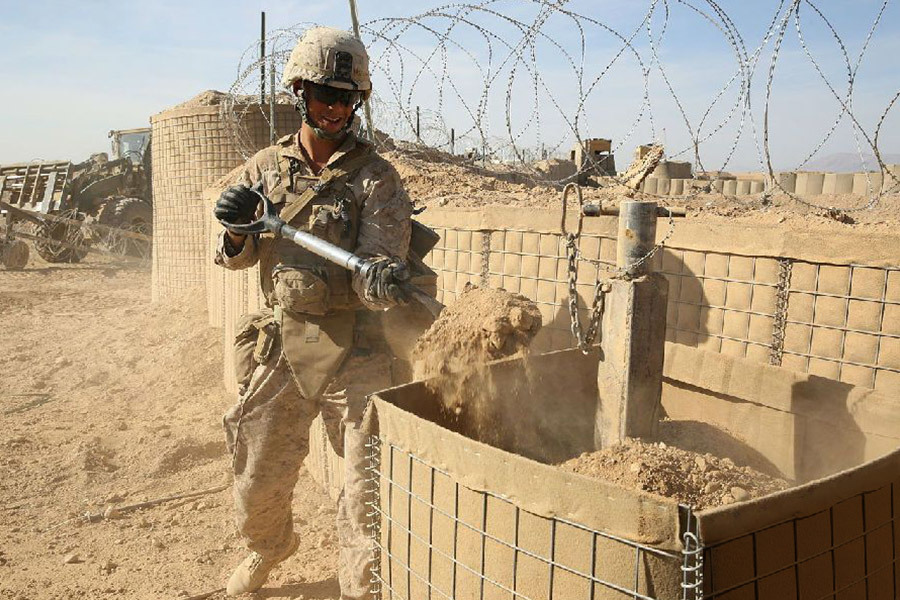
The gabion-style defensive barrier — such as the CP0035 product — is a modern evolution of traditional military fortification. It consists of a collapsible welded mesh frame lined with non-woven geotextile fabric, filled on-site with local aggregate, sand, or crushed stone. The result is a blast wall rated against small-arms fire and explosive overpressure. Actual field testing confirms that a standard 1m × 1m × 2m unit filled with compacted gravel reduces projectile penetration to near zero at ranges exceeding 50 metres.
The structural integrity comes from hot-dip galvanised or zinc-aluminium coated steel mesh — a coating choice that matters in Singapore's humid tropical climate, where untreated carbon steel can corrode within 18 months. Spiral-hinged corners allow rapid deployment: a two-person team can erect a 10-metre blast wall line in under four hours. Units are available in beige or green to suit urban or vegetated environments.
2. Concrete and crash barriers
Concrete barriers — including the widely recognised Jersey barrier profile — are the backbone of vehicle access control across Singapore's expressways and critical facilities. As a crash barrier, a standard concrete unit weighing 800–1,200 kg can absorb a vehicle impact of up to 7,500 kg at 80 km/h when anchored correctly. They function equally as a perimeter defence along construction sites and as a temporary security perimeter at public events. The limitation? Permanent installation requires civil foundation work and Urban Redevelopment Authority (URA) approval for streetscape impact.
3. Bollard systems
A bollard system offers the cleanest aesthetic solution for urban environments. Fixed steel bollards, retractable hydraulic bollards, and surface-mounted security bollards each serve different threat levels. In Singapore's Orchard Road pedestrian zone, retractable bollards allow authorised delivery vehicles through during off-peak hours while maintaining an anti-vehicle barrier during peak pedestrian periods. IWA 14-1 impact-tested bollards can stop a 7,200 kg vehicle travelling at 50 km/h within 1 metre of impact.
4. Security fencing and perimeter wall systems
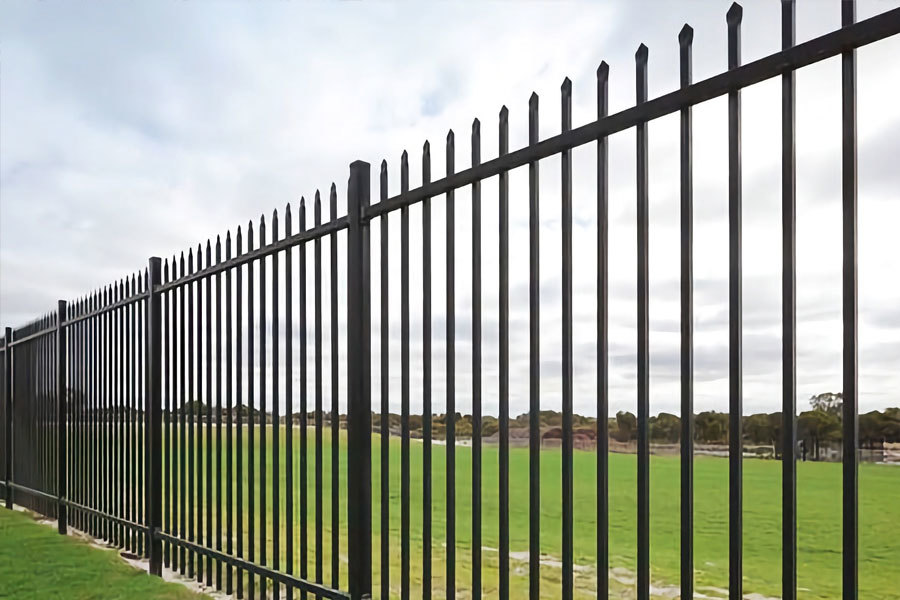
A security fence or perimeter wall forms the outer layer of layered perimeter defence. High-security welded mesh panels, anti-climb palisade fencing, and reinforced perimeter walls are standard around Singapore's water treatment plants, data centres, and MRT depots. These systems are often paired with intrusion detection sensors — essentially transforming a passive protective wall into an active anti-intrusion barrier.
5. Water-filled and temporary barriers
Water-filled plastic barriers (commonly called water horses or water mares) offer rapid deployment for event security perimeters and road diversions. Empty units weigh roughly 12 kg and can be transported easily; once filled, a standard 1.2m unit provides effective crowd and light vehicle deterrence. They are not rated for high-speed vehicle impact, which is a critical limitation to understand before specifying them for counter-terrorism applications.
Singapore compliance and regulatory standards
Compliance in Singapore is multi-layered. Specifying the wrong barrier type — or installing the right type without the correct approvals — can result in project delays, fines, or mandatory removal. Here is what applies in 2026.
BCA structural and load requirements
The Building and Construction Authority (BCA) governs structural safety of all permanent barrier installations. Permanent concrete barriers, perimeter walls above 1.8 metres, and anchored bollard systems require a Qualified Person (QP) submission and structural calculation endorsement. BCA's 2026 updates specifically address earth-retaining structures — meaning a retaining wall used as a perimeter defence at a sloped site needs both geotechnical and structural PE endorsement.
URA public space and streetscape guidelines
The Urban Redevelopment Authority (URA) regulates the visual and spatial impact of barriers in public-facing zones. Any security fence or protective wall visible from a public road or pedestrian pathway within designated urban design areas — including the Central Business District and Orchard Road — requires URA's approval under the Streetscape Improvement Scheme. Designs must balance security function with aesthetic continuity. Interestingly, bollard systems generally receive faster URA clearance than solid perimeter walls because they preserve visual permeability.
MHA counter-terrorism barrier standards
The Ministry of Home Affairs (MHA), through its Security Industry Regulatory Department, publishes mandatory vehicle access control requirements for Tier 1 and Tier 2 critical infrastructure operators. For high-footfall public venues, MHA recommends IWA 14-1 or PAS 68-certified anti-vehicle barriers at all primary pedestrian access points. The Securing Our Tomorrow initiative also encourages owners of large shopping malls and transport hubs to conduct a Security by Design (SBD) review that explicitly evaluates the physical security barrier layout before construction or major renovation.
"Effective perimeter security is not just about installing a barrier — it is about integrating structural, operational, and cyber controls into a unified defence framework." — Security Industry Regulatory Department, MHA Singapore, 2025 Security Design Guidelines
Permanent vs temporary barriers: which should you choose?
This is the question most project managers ask — and the answer is never as straightforward as it seems. The choice between a permanent fortification and a deployable temporary barrier hinges on four variables: threat duration, regulatory pathway, budget cycle, and site reversibility.
| Factor | Permanent barrier | Temporary/deployable barrier |
|---|---|---|
| Threat profile | Long-term, defined perimeter (critical infrastructure) | Short-term, shifting perimeter (events, construction) |
| Vehicle impact rating | IWA 14-1 / PAS 68 certifiable | Light vehicle deterrence only (water barriers) |
| Regulatory pathway | BCA QP submission, URA approval required | SLA/LTA traffic scheme permit for road use |
| Deployment time | Weeks to months | Hours to days |
| Cost (indicative, SGD) | SGD 800–4,500 per linear metre | SGD 80–350 per linear metre (rental basis) |
| Site reversibility | Removal costly; civil reinstatement needed | Fully reversible; no civil works |
| Best for | Data centres, airports, government buildings | Concerts, marathons, pop-up markets |
Of course, there are situations where a hybrid approach is optimal. Changi Airport's landside perimeter, for instance, combines a fixed anti-intrusion barrier along the boundary with deployable crash barriers at high-traffic entry points during peak periods — allowing operational flexibility without compromising the certified security perimeter.
Step-by-step: how to select the right barrier type
- Define the threat: Is the primary risk vehicle ramming, unauthorised pedestrian intrusion, blast overpressure, or a combination?
- Assess site duration: Will the barrier be in place for less than 30 days, or is this a permanent installation?
- Check regulatory triggers: Does the site fall within a BCA controlled zone, URA urban design area, or MHA-designated critical infrastructure tier?
- Calculate load requirements: Obtain the vehicle mass and speed parameters from your security risk assessment to match against barrier impact ratings.
- Evaluate total cost of ownership: Include installation, civil works, maintenance, and eventual removal or replacement costs.
- Specify and procure: Request product data sheets confirming coating standard (hot-dip galvanised per AS/NZS 4680 or equivalent) and impact test certification.
Real deployment cases in Singapore
Abstract specifications become far more meaningful when grounded in real deployment scenarios. The following cases reflect actual approaches observed across Singapore's major public infrastructure projects in recent years.
Gardens by the Bay — perimeter defence integration
Gardens by the Bay manages a complex security challenge: it is a soft target with high international footfall, yet it must preserve its world-class landscape aesthetic. The solution deployed across its Marina South entrance combines flush-mount hydraulic bollards with a low-profile perimeter wall integrated into the garden's planting beds. The bollard system meets IWA 14-1 certification, while the perimeter wall uses a reinforced concrete core clad in natural stone — a design that satisfies both MHA's counter-terrorism requirements and URA's waterfront streetscape guidelines.
Orchard Road pedestrian zone — event barrier deployment
During major events on Orchard Road — including the annual Christmas light-up and National Day celebrations — the Singapore Police Force and event organisers deploy a layered access control barrier arrangement. Water-filled plastic crash barriers form the outer cordon along vehicle entry points; inside, interlocking steel crowd-control barriers define pedestrian flow lanes. According to near-term operational data reviewed in 2026, this arrangement allows full perimeter setup within six hours and supports crowd densities exceeding 50,000 people without structural incident.
Changi Airport environs — military-grade gabion elements
At certain restricted perimeter sections adjacent to Changi Airport's airside boundary, modular gabion defensive barriers provide blast protection and anti-intrusion deterrence simultaneously. The galvanised welded mesh units are filled with locally sourced granite aggregate — a practical choice given Singapore's active quarry imports from regional suppliers. Just as a layered coat of armour distributes impact across its surface, the gabion structure dissipates blast energy through its granular mass rather than relying on a single rigid face, making it more effective per unit cost than an equivalent solid concrete blast wall at the same location.
Cyber and physical barrier convergence in smart cities
Singapore's Smart Nation initiative has fundamentally changed how security perimeters are designed. In 2026, a physical security barrier rarely operates in isolation — it is increasingly one node in an integrated cyber-physical security architecture.
What cyber-physical convergence means in practice
An access control barrier at a data centre gate, for example, may be physically a reinforced steel vehicle barrier with a hydraulic actuator. But its operational logic is governed by a software-defined access control platform connected to biometric authentication, CCTV analytics, and a Security Operations Centre (SOC). If the cyber layer is compromised — through a spoofed RFID credential or a manipulated sensor feed — the physical barrier can be rendered ineffective without a single bolt being moved. This is why 2026 security design briefs in Singapore consistently require both a physical security barrier specification and a cyber resilience assessment under the Cybersecurity Act framework managed by CSA Singapore.
Emerging standards for integrated defensive barrier systems
The Cyber Security Agency of Singapore (CSA) and MHA are progressively aligning physical barrier standards with the Operational Technology (OT) security guidelines. For new critical infrastructure projects, the expectation is that fortification and barriers at the perimeter are part of a documented defence-in-depth architecture — one that accounts for both physical breach scenarios and cyber-enabled bypass scenarios. Specifiers who treat physical barriers and cyber controls as separate procurement streams are increasingly flagged during regulatory review.
Cost guide for SMEs and event organisers
Budget is always the practical constraint. For SMEs and event organisers in Singapore, the headline question is: what does a functional defensive barrier actually cost, and is it worth it?
Indicative cost ranges (SGD, 2026)
The figures below are based on 2026 market data from Singapore-based security contractors and barrier rental companies. Prices vary with site conditions, access constraints, and order volume.
| Barrier type | Purchase (SGD/unit) | Rental (SGD/unit/day) | Typical use case |
|---|---|---|---|
| Gabion defensive barrier (1m³) | SGD 180–320 | N/A (purchase only) | Military, flood control, perimeter fortification |
| Concrete Jersey barrier (3m) | SGD 400–750 | SGD 18–35 | Road diversion, site boundary |
| Water-filled crash barrier (1.2m) | SGD 120–200 | SGD 8–20 | Events, construction zone |
| Fixed steel bollard (surface mount) | SGD 350–900 | N/A | Storefronts, pedestrian zones |
| Hydraulic retractable bollard | SGD 4,500–12,000 | N/A | Vehicle access control at high-security sites |
| Security fence (welded mesh, per 10m) | SGD 600–1,400 | SGD 40–90 | Construction perimeter, facility boundary |
ROI framing for SMEs
The return on investment argument for physical security barriers is often framed incorrectly. The question is not "what does a barrier cost?" but rather "what is the cost of a single breach event?" For a retail SME in Orchard Road, a vehicle intrusion incident can result in property damage exceeding SGD 200,000, business interruption losses, and reputational harm. A compliant bollard system costing SGD 15,000–25,000 installed amortises to under SGD 3,000 per year over a ten-year lifecycle — less than the monthly premium on some commercial property insurance policies. When viewed through this lens, the defensive barrier becomes not a cost centre but a risk mitigation asset.
For event organisers, budget allocation is more event-specific. A mid-scale event of 5,000 attendees in a public park typically requires a security perimeter of 300–500 linear metres. Using water-filled crash barriers on a daily rental basis, the perimeter cost sits between SGD 2,400 and SGD 10,000 — a manageable line item within a standard event production budget.
Choosing the right defensive barrier: a final summary
The 2026 landscape for defensive barriers in Singapore is more complex — and more capable — than at any prior point. The range of available solutions, from ancient fortification principles re-engineered in modern gabion form to smart bollard systems governed by cyber-physical access control platforms, means there is no universal answer. What does hold universally is the principle of proportionality: the barrier you specify should match the threat, the regulatory environment, and the site constraints specific to your project.
Whether you are protecting a data centre perimeter with a certified physical security barrier, securing an event space with temporary crash barriers, or designing a blended cyber-physical defensive barrier for a smart city application, the fundamentals remain constant: define the threat clearly, verify the regulatory pathway early, and specify to a documented standard rather than a generic description. That discipline is what separates a barrier that works from one that merely exists.
Frequently asked questions
Q: What is the difference between a defensive barrier and a retaining wall?
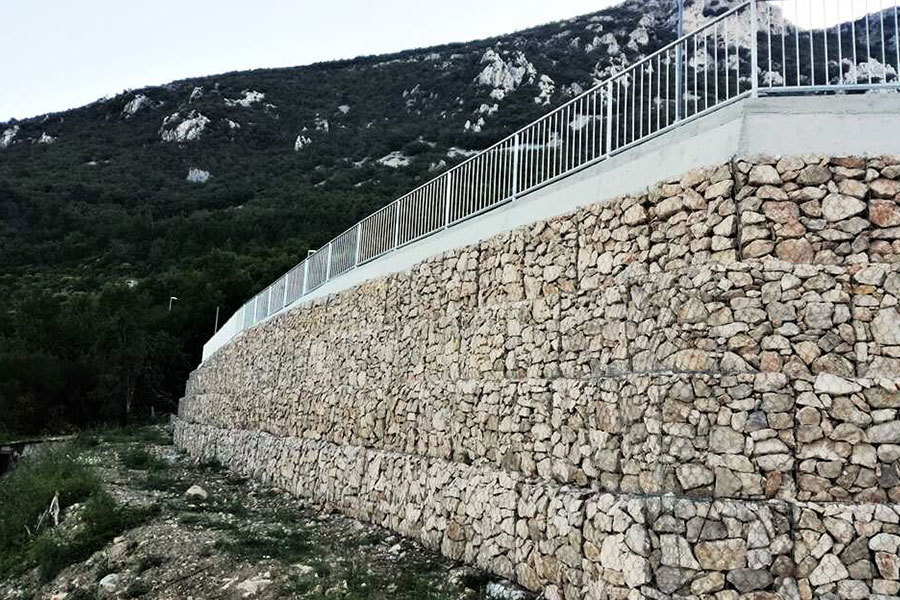
A: A retaining wall is designed primarily to resist lateral earth or water pressure and prevent soil movement. A defensive barrier is engineered to resist human-induced threats — vehicle impact, blast overpressure, or unauthorised intrusion. The two may share structural form but are designed to entirely different load criteria and compliance standards.
Q: Do I need BCA approval for a temporary defensive barrier in Singapore?
A: Temporary barriers below 1.8 metres in height that are not structurally fixed to the ground typically do not require BCA submission. However, if the barrier is on a public road or footpath, an LTA or SLA permit is required. For event use, NEA and SPKA approvals may additionally apply depending on the venue and event size.
Q: Are gabion defensive barriers suitable for flood control as well as blast protection?
A: Yes. Modular gabion barriers serve a dual function. When filled with aggregate and properly lined with geotextile fabric, they resist hydrostatic pressure effectively, making them widely used in both flood control engineering and military blast wall applications. This dual-use capability is a key reason they are favoured in forward-deployed or rapidly changing environments.
Q: What impact rating should I specify for a bollard system in Singapore?
A: MHA guidance for high-footfall public venues recommends IWA 14-1 or PAS 68-rated bollards at primary vehicle entry points. For lower-risk pedestrian areas, surface-mounted fixed bollards without formal impact certification are generally acceptable. Always cross-reference with your site's MHA security tier classification before finalising the specification.
Q: How long does a hot-dip galvanised defensive barrier last in Singapore's climate?
A: In Singapore's humid tropical environment, hot-dip galvanised steel conforming to AS/NZS 4680 typically provides 20–30 years of corrosion protection when properly installed and not damaged. Zinc-aluminium coated alternatives offer comparable or superior performance in coastal or industrial atmospheric conditions. Periodic inspection every three to five years is recommended to identify early-stage coating degradation.
Get A Quote
Note: Please leave your email address, our professionals will contact you as soon as possible!
Spotlight





Official Website
Hello, What can we do for you?
*Note: Please be sure to fill in the information accurately and keep the communication unblocked. We will contact you as soon as possible


